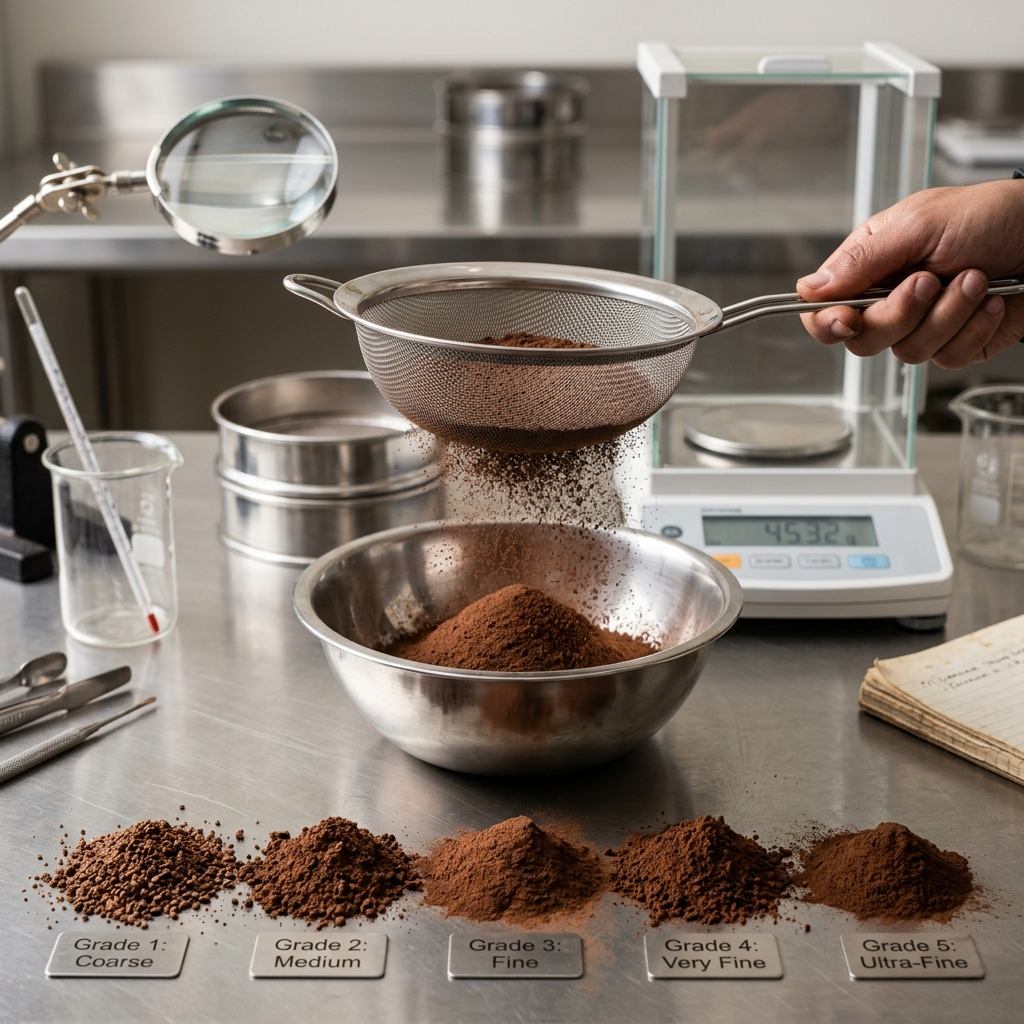
Does Cocoa Powder Particle Size Really Matter for My Application?
Absolutely. Particle size distribution (PSD) controls three critical end-product attributes: mouthfeel, suspension stability, and flavor release kinetics. Yet most B2B purchase orders still only specify fat content and pH — overlooking the single variable that causes the most batch-to-batch inconsistency in finished goods.
The Industry Baseline: 99.5% Passing 75 Microns
The minimum accepted fineness standard across most international cocoa powder specifications is 99.5% of particles passing through a 75-micron (200 mesh) sieve. This threshold eliminates visible grit and ensures basic compatibility with industrial mixing and dosing equipment. However, "passing 75 microns" says nothing about where the majority of particles actually fall within that range — and that distribution is where application performance diverges.
Beverage-Grade Cocoa Powder: <30 Microns for Suspension Stability
Ready-to-drink (RTD) chocolate beverages, instant hot cocoa mixes, and cocoa-flavored protein shakes demand the finest particle size of any application category. The reason is physics: larger particles settle faster under gravity (Stokes' Law), creating visible sedimentation and an unacceptable consumer experience.
- Target PSD: D90 < 30 µm (meaning 90% of particles must be below 30 microns). Premium RTD formulations often target D90 < 20 µm.
- Fat content pairing: Low-fat cocoa powder (10–12%) is preferred for beverages. Higher fat content (20–22%) increases particle hydrophobicity, resistance to wetting, and tendency to form surface clumps.
- Lecithination: For instant-dissolving cold-water applications, request lecithinated cocoa powder — particles coated with soy or sunflower lecithin (0.3–0.5%) to dramatically improve wettability regardless of base particle size.
- Quality checkpoint: Request laser diffraction PSD data (not just sieve analysis) on your CoA. Sieve analysis at 75 µm does not resolve distribution differences below 30 µm.
Confectionery-Grade Cocoa Powder: 15–25 Microns for Smooth Mouthfeel
In chocolate manufacturing, compound coatings, and praline fillings, particle size directly determines perceived texture on the palate. Human sensory perception detects graininess above approximately 25 microns — meaning any particles exceeding this threshold will register as "gritty" to the consumer.
- Target PSD: D90 between 15–25 µm. This range delivers the smooth, melting sensation consumers associate with premium chocolate.
- Danger zone: Going too fine (<10 µm D90) creates its own problems — an overly chalky mouthfeel, disproportionally intense flavor release, and increased surface area that accelerates fat bloom during storage.
- Fat content pairing: Higher-fat cocoa powder (20–22%) is generally preferred in confectionery for richer flavor and improved integration with cocoa butter and fat-based systems.
- Consistency requirement: Specify acceptable PSD variance between batches (e.g., D50 ± 2 µm). Even small distribution shifts can alter coating viscosity and enrobing line performance.
Bakery-Grade Cocoa Powder: Standard Fineness, Focused on Chemistry
Bakery applications — cakes, cookies, brownies, bread — are the most forgiving on particle size. Standard industrial grade (99.5% < 75 µm) is typically sufficient because the cocoa powder is hydrated into a batter matrix and then heat-set during baking, eliminating most particle-size-related texture concerns.
- Target PSD: Standard specification (99.5% passing 75 µm) is adequate. D50 values between 20–40 µm are common and acceptable.
- Primary selection criteria: For bakery, the critical parameters are pH (natural vs. alkalized for leavening chemistry), color intensity (consumer perception), and fat content — not particle fineness.
- Exception — premium pastry: High-end patisserie (ganache, mousse, soufflé) requires confectionery-grade fineness (D90 < 25 µm) because these products are not baked and the cocoa is consumed in a semi-liquid matrix.
How to Specify Particle Size on Your Purchase Order
Most batch-to-batch quality issues stem from incomplete specifications. Here is the minimum data your procurement team should include when sourcing cocoa powder for any application:
- Sieve specification: "99.5% minimum passing 75 µm" (baseline for all grades).
- Laser diffraction PSD: Specify D10, D50, and D90 values appropriate for your application (see targets above).
- Acceptable variance: Define batch-to-batch tolerance (e.g., "D50 = 18 µm ± 3 µm").
- Test method: Specify which measurement standard you require (ISO 13320 for laser diffraction, or AOAC method for sieve analysis).
- CoA requirement: Mandate that every shipment includes PSD data — not just a generic "fineness: pass" notation.
Particle size is not a premium specification — it is a fundamental quality parameter that should appear on every cocoa powder purchase order alongside fat content, pH, and moisture. Suppliers who cannot provide batch-specific PSD data measured by laser diffraction are not equipped for modern food manufacturing partnerships.